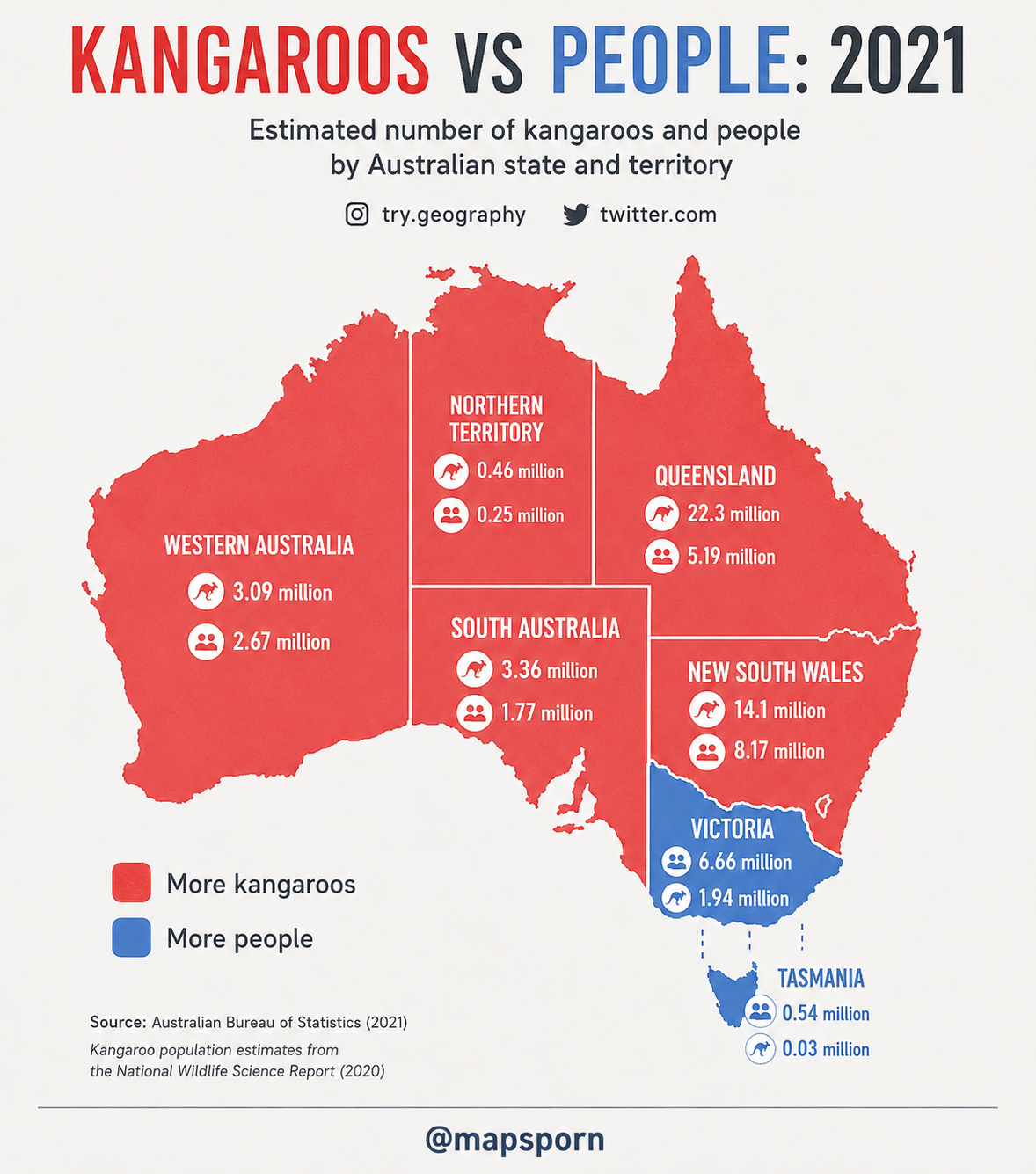
Australia is famous for its beaches, deserts and unusual wildlife—but this map reveals a statistic that may be even more surprising: kangaroos appear to outnumber people across most of the country.
Using 2021 human population figures and kangaroo estimates shown in the infographic, five of Australia’s major states and territories had more kangaroos than residents. Only Victoria and Tasmania recorded more people than kangaroos.
And in some places, the difference was enormous.
Queensland Is the Undisputed Kangaroo Capital
Queensland had the most dramatic comparison on the map:
- Kangaroos: 22.3 million
- People: 5.19 million
That works out to more than four kangaroos for every person.
Queensland’s enormous size, extensive grasslands and large rural areas provide suitable habitats for several kangaroo species. While most residents live in cities and coastal communities, kangaroos are spread across vast inland regions.
New South Wales Has Millions More Kangaroos Than People
New South Wales may contain Sydney, Australia’s largest city, but its estimated kangaroo population still exceeded its human population:
- Kangaroos: 14.1 million
- People: 8.17 million
The difference is especially striking because New South Wales is one of Australia’s most heavily populated states. Beyond Sydney and other urban centers, however, the state contains enormous agricultural and natural landscapes where kangaroos are common.
South Australia Has Nearly Twice as Many Kangaroos
South Australia also leaned heavily toward wildlife:
- Kangaroos: 3.36 million
- People: 1.77 million
Much of the state’s population is concentrated around Adelaide, leaving large inland areas sparsely populated by humans. Kangaroos, meanwhile, can occupy grasslands, scrublands and semi-arid environments across the state.
Kangaroos Slightly Outnumber People in Western Australia
Western Australia showed a much closer contest:
- Kangaroos: 3.09 million
- People: 2.67 million
Most Western Australians live in and around Perth, while the rest of the state covers an immense area. Western Australia is so large that even a relatively low population density can create plenty of room for wildlife.
Even the Northern Territory Has More Kangaroos
The Northern Territory had the smallest human population shown on mainland Australia:
- Kangaroos: 460,000
- People: 250,000
That is approximately 1.8 kangaroos for every resident.
The comparison illustrates just how sparsely populated the territory is. Its enormous landscapes contain only a handful of major population centers, including Darwin and Alice Springs.
Victoria Breaks the Pattern
Victoria was one of only two regions on the map where people outnumbered kangaroos:
- People: 6.66 million
- Kangaroos: 1.94 million
Victoria is Australia’s smallest mainland state and contains the densely populated city of Melbourne. Its relatively compact land area and high urban population help explain why humans hold such a clear numerical advantage.
There were roughly three people for every kangaroo in the state.
Tasmania Has Far More People Than Kangaroos
Tasmania showed the largest human advantage:
- People: 540,000
- Kangaroos: 30,000
This comparison requires some context. Tasmania does not have the same large mainland kangaroo populations found in states such as Queensland and New South Wales. The island is instead known for other marsupials, including wallabies, pademelons and Tasmanian devils.
How Many Kangaroos Are Shown Altogether?
Adding the figures displayed on the map produces an estimated total of:
- Approximately 45.28 million kangaroos
- Approximately 25.25 million people
Based on those numbers, there were roughly 1.8 kangaroos for every person across the regions included.
However, the infographic does not list the Australian Capital Territory separately. Its human population would slightly increase the national total.
Why Kangaroo Numbers Can Change So Quickly
Human populations generally change gradually. Kangaroo populations can rise or fall much more dramatically.
Rainfall is one of the most important factors. Wet conditions can produce more grass, vegetation and water, allowing kangaroo populations to grow. Prolonged droughts, bushfires, habitat changes and food shortages can cause numbers to decline.
This means a kangaroo estimate from one year should not be treated as a permanent count.
These Figures Are Estimates, Not an Exact Census
Nobody counts every kangaroo individually.
Wildlife agencies usually estimate kangaroo populations using methods such as aerial surveys and statistical sampling. Some official monitoring programs focus mainly on particular species and regions where commercial harvesting is managed.
As a result, kangaroo figures from different reports may cover different areas, species or survey periods. The map is best understood as a striking comparison based on the estimates available—not a precise headcount of every kangaroo in Australia.
A Country Where Wildlife Still Dominates the Landscape
Australia’s population is highly concentrated in a relatively small number of coastal cities. Kangaroos, by contrast, occupy enormous rural and inland landscapes.
That helps explain the map’s most surprising message: despite Australia’s modern cities and growing population, much of the continent remains so vast and sparsely settled that one of its most famous animals can still outnumber its people.
In Queensland, the difference is overwhelming. In Victoria and Tasmania, humans are comfortably ahead. Across the country as a whole, however, the kangaroo remains a powerful symbol of just how wild Australia still is.
