A lobster dinner may look similar in Paris, Oslo, London or Zurich—but the laws governing how that lobster reaches the plate can be remarkably different.
Across Europe, governments are taking increasingly different approaches to one controversial question:
Should a conscious lobster ever be placed directly into boiling water?
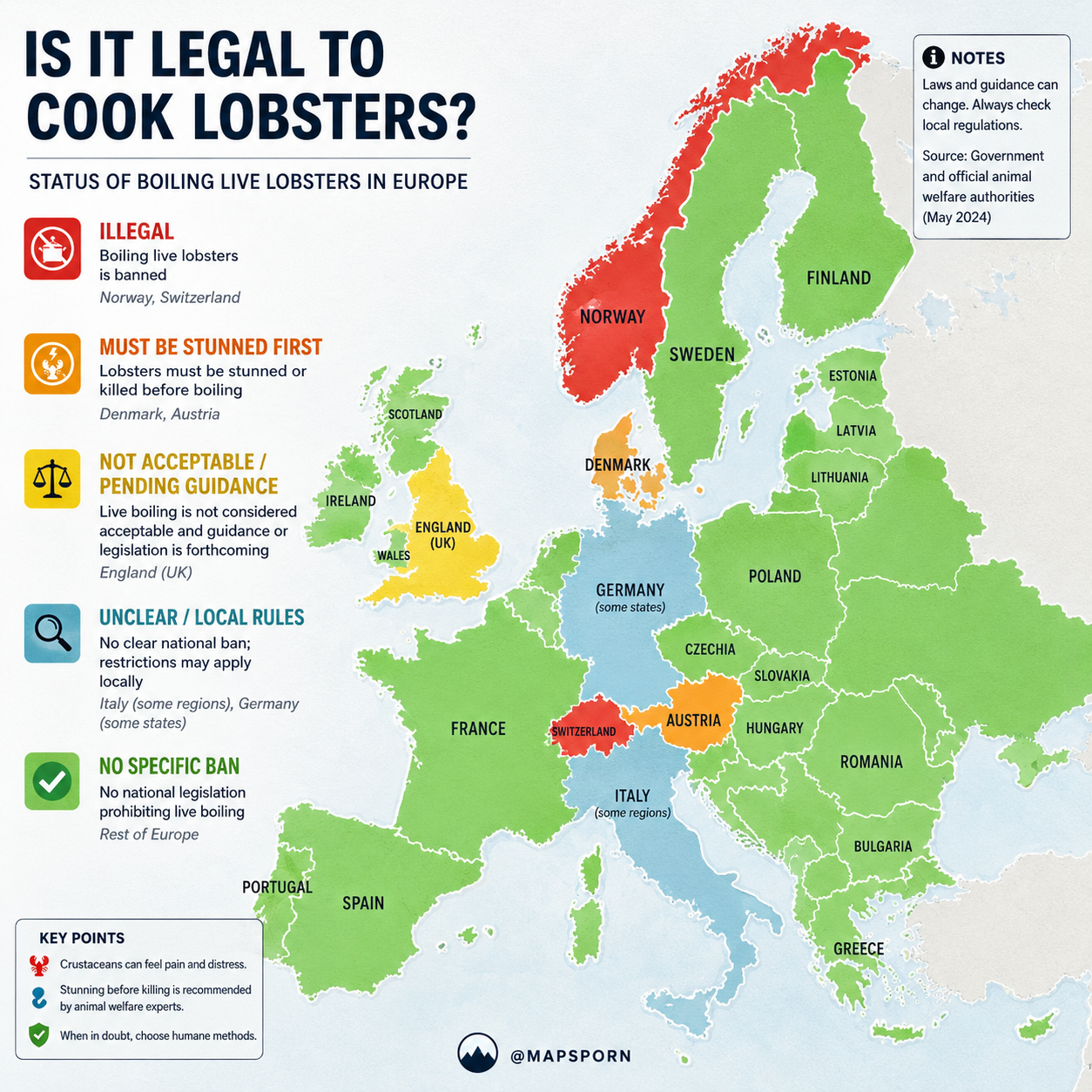
The map divides Europe into five categories, ranging from countries with no specific national prohibition to places where live boiling is banned or requires prior stunning. It creates a dramatic picture of Europe’s changing attitudes toward crustacean welfare—but the legal reality is more complicated than a simple red-or-green map suggests.
Switzerland Does Not Ban Lobster—It Regulates How It Is Killed
Switzerland is presented as one of Europe’s strictest countries, but the distinction is important: cooking and eating lobster remain legal.
Swiss rules require certain crustaceans to be stunned and then killed immediately. Official federal regulations permit immersion in boiling water as a killing method only after stunning has occurred. In other words, the prohibited practice is placing a conscious lobster directly into the pot—not cooking lobster altogether. (Fedlex)
This makes Switzerland a useful example of how easily the issue can be misunderstood. Headlines may say that “boiling lobster is illegal,” when the law is actually focused on whether the animal is conscious when boiling begins.
Norway Also Takes a Strict Approach
Norway is another country highlighted in red.
The Norwegian Food Safety Authority states that restaurants, shops and other businesses preparing crabs must stun them before boiling. This reflects the country’s broader position that commercial food preparation should avoid boiling conscious crustaceans. (Mattilsynet)
That does not mean every legal detail is identical for every species, situation or private household. It does show, however, that Norway expects food businesses to treat crustacean welfare as more than an optional ethical consideration.
Austria and Denmark Require More Humane Preparation
The map places Austria and Denmark in the orange category, indicating that lobsters must be stunned or killed before being boiled.
Rather than prohibiting lobster dishes, this approach regulates the preparation process. Restaurants can continue serving lobster, but the animal should not remain conscious when exposed to boiling water.
Austria’s animal-welfare framework is unusually broad because its protections extend beyond vertebrates to include cephalopods and decapod crustaceans. It prohibits causing animals unjustified pain, suffering, injury or extreme anxiety. (World Animal Protection)
The practical requirements can depend on how national animal-welfare laws, food-industry regulations and official veterinary guidance interact. That is one reason restaurant operators should consult current local authorities rather than relying entirely on a social-media map.
England’s Position Is Changing
England appears in yellow on the map, described as a place where live boiling was considered unacceptable but where detailed legislation or guidance was still developing.
That reflected the situation when the map was created. However, England has since moved further.
The United Kingdom’s Animal Welfare (Sentience) Act recognizes decapod crustaceans—including lobsters, crabs and shrimp—as animals for the purposes of government policy concerning animal sentience. Recognition alone did not immediately prohibit existing restaurant practices. (Legislation.gov.uk)
In December 2025, the British government’s animal-welfare strategy for England committed to publishing guidance clarifying that live boiling is not an acceptable method of killing decapods. This means the map’s yellow classification is now incomplete and should not be treated as a current legal summary for England. (GOV.UK)
Scotland, Wales and Northern Ireland have their own legal and regulatory responsibilities, so the position may not be identical throughout the United Kingdom.
Germany and Italy Show Why National Maps Can Be Misleading
Germany and Italy are colored blue, indicating unclear or locally varying rules.
This category may be the most important one on the entire map.
A country does not always need a single nationwide law specifically mentioning lobsters. Rules may instead come from:
- General animal-welfare legislation
- Regional or state regulations
- Court decisions
- Food-business licensing requirements
- Veterinary guidance
- Local enforcement policies
Italy is divided into regions and municipalities that can adopt different animal-welfare measures. Germany’s federal structure can also create differences in interpretation and enforcement between states.
A restaurant operating legally in one city should not assume that the same procedure is automatically permitted everywhere else.
Green Does Not Necessarily Mean “Approved”
Most of Europe appears green, representing countries where the map found no specific national ban on live boiling.
That color should not be interpreted as official approval of the practice.
“No specific ban” may simply mean that researchers could not identify a national law explicitly addressing live lobster boiling. Broader rules against unnecessary suffering may still apply, while industry codes or local authorities may recommend more humane methods.
The absence of a narrowly worded statute is not the same as legal certainty.
Why Are Lobsters Receiving Greater Protection?
For many years, lobsters and other crustaceans were treated differently from mammals, birds and other vertebrates. Their nervous systems are structured differently, leading some people to assume their reactions to injury were simple reflexes rather than evidence of pain.
Scientific understanding has shifted.
A major London School of Economics review evaluated more than 300 studies involving cephalopod molluscs and decapod crustaceans. Researchers found substantial evidence supporting sentience in animals including lobsters, crabs and crayfish. The findings helped influence the United Kingdom’s decision to recognize these animals in its sentience legislation. (LSE Primary)
Scientists still debate how the experience of pain in a lobster compares with pain in humans or other animals. The growing legal trend is based on a precautionary idea: when credible evidence suggests that an animal may experience pain or distress, avoid methods that could cause prolonged suffering.
Why Haven’t All European Countries Adopted the Same Rule?
Animal-welfare law varies widely across Europe because every country balances scientific evidence, cultural traditions, enforcement costs and food-industry practices differently.
Several practical questions also complicate regulation:
What qualifies as effective stunning? Which species should be covered? Does a rule apply only to restaurants, or also to private kitchens? Who is responsible for enforcement? What equipment must food businesses purchase?
Even countries that agree live boiling is undesirable may take different legal routes. One may impose a direct statutory ban, while another relies on general welfare legislation or professional guidance.
“Alive” and “Conscious” Are Not Always the Same Legal Question
Public discussions often use the phrase “boiling a lobster alive,” but many regulations focus more precisely on consciousness.
An animal may be killed immediately before cooking and therefore still show movement caused by residual nerve activity. Conversely, an animal may be immobilized without having been effectively rendered unconscious.
That is why some authorities emphasize approved stunning rather than merely cooling or restraining the animal. The legal and ethical objective is generally to prevent avoidable pain and distress—not simply to stop visible movement.
What Restaurants and Home Cooks Should Know
Anyone preparing live crustaceans should check the latest rules issued by the relevant national, regional and municipal authorities. Laws and official guidance can change, and a map created in 2024 cannot capture every later development.
Businesses face an especially high responsibility because commercial food preparation may be subject to stricter animal-welfare, licensing and inspection requirements than private cooking.
Where the law is unclear, the safer approach is to avoid placing a conscious crustacean directly into boiling water and follow methods endorsed by qualified veterinary or animal-welfare authorities.
One Continent, Many Different Rules
The most striking message from this map is not that lobster is illegal in parts of Europe. It is that European countries increasingly disagree about what counts as an acceptable way to prepare it.
Switzerland tightly regulates the process. Norway requires commercial operators to stun crustaceans before boiling. Austria and Denmark are presented as requiring prior stunning or killing. England has moved from recognition of crustacean sentience toward guidance declaring live boiling unacceptable. Elsewhere, national rules may be absent, unclear or locally determined.
The traditional image of a live lobster being dropped directly into a steaming pot is therefore no longer universally accepted.
Across Europe, the question is shifting from “Can we cook it?” to “How can it be prepared without avoidable suffering?”
Legal note: This article provides general information, not legal advice. Regulations can change and may vary by region, species and commercial setting.
