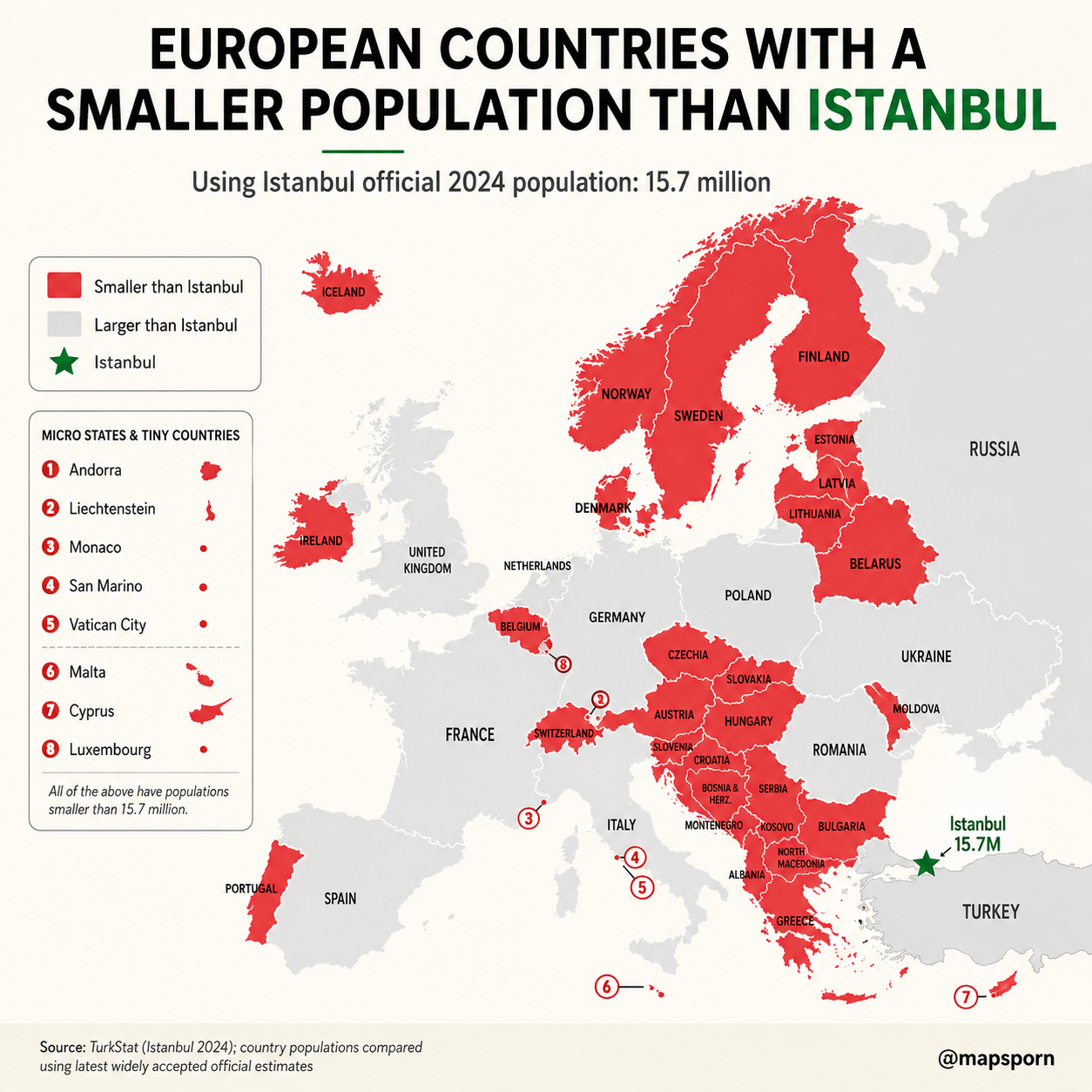
Istanbul is not a country, but its population is larger than that of most countries in Europe.
According to the official 2024 figure shown on the map, Istanbul had approximately 15.7 million residents. That means more people lived in this single Turkish metropolis than in countries such as Sweden, Portugal, Belgium, Greece, Austria and the Czech Republic.
Altogether, 36 European countries and microstates had populations below Istanbul’s total.
The comparison reveals just how enormous Istanbul has become—and why ordinary maps often fail to communicate the true scale of the city.
A City Larger Than Entire Nations
When people picture a major European city, they might think of Paris, London, Rome or Berlin. Istanbul belongs in a different population category.
Its 15.7 million residents exceed the populations of many well-known European countries, including:
- Sweden
- Portugal
- Greece
- Belgium
- Czechia
- Hungary
- Austria
- Switzerland
- Bulgaria
- Serbia
Each of these countries has its own government, cities, transportation networks and national institutions. Yet none has as many residents as Istanbul alone.
The contrast is especially striking with countries such as Iceland, Montenegro and Luxembourg, where the total national population represents only a small fraction of Istanbul’s.
Istanbul Has Nearly Three Times Finland’s Population
Finland is one of the largest countries in Europe by land area, but it has only about a third as many residents as Istanbul.
The reason is population density.
Finland has enormous forests, lakes and sparsely populated northern regions. Istanbul, by contrast, concentrates millions of people within a relatively compact urban area surrounding the Bosporus.
A visitor can travel for hours through lightly populated Finnish landscapes. In Istanbul, neighborhoods, apartment blocks, commercial districts and transportation corridors stretch continuously across both sides of the city.
More People Than Sweden or Portugal
Sweden and Portugal are not tiny countries. Both are established European nations with multiple major cities and millions of residents.
Even so, neither reaches Istanbul’s 15.7 million population.
Sweden has a large geographic area but a relatively low population density, particularly in its northern regions. Portugal’s population is more concentrated, especially around Lisbon and Porto, but its national total still falls several million short of Istanbul’s.
The comparison demonstrates that Istanbul is not merely a large city by regional standards. It is a population center comparable to a medium-sized country.
Bigger Than Belgium, Greece and Czechia
Belgium contains Brussels, Antwerp, Ghent and several other major urban areas. Greece includes Athens, Thessaloniki and hundreds of inhabited islands. Czechia has Prague, Brno and a network of smaller cities and towns.
Yet the entire population of each country is smaller than Istanbul’s.
This can be difficult to imagine because national borders appear so prominent on maps. Countries look visually significant, while cities are often represented by a small dot.
Population maps tell a very different story.
A single dot representing Istanbul contains more people than all the towns, villages and cities of many countries combined.
The Nordic Countries Look Very Different
Every independent Nordic country shown on the map—apart from no relevant larger exception—is below Istanbul’s population individually.
Norway, Sweden, Finland, Denmark and Iceland all have fewer residents than the Turkish metropolis.
These countries cover huge areas, but much of their territory is mountainous, forested, cold or otherwise lightly populated. Their populations are distributed across numerous cities and smaller settlements.
Istanbul concentrates more people into one connected metropolitan environment than any of them contains nationwide.
Most of the Balkans Have Smaller Populations
The map becomes almost entirely red across the Balkans.
Greece, Bulgaria, Serbia, Croatia, Bosnia and Herzegovina, Albania, North Macedonia, Slovenia, Montenegro and Kosovo all have populations below Istanbul’s.
In fact, Istanbul has long served as an economic, cultural and transportation hub for the wider Balkan, Black Sea and eastern Mediterranean regions.
Its enormous population reflects centuries of migration, commerce and political importance. People continue to move to the city for employment, education and access to services, reinforcing its position as one of Europe’s largest urban centers.
Even Several Countries Combined Would Be Smaller
The most dramatic comparisons involve Europe’s smallest nations.
Istanbul has more people than Iceland, Malta, Luxembourg, Montenegro and Cyprus combined. It also dwarfs the microstates of Andorra, Liechtenstein, Monaco, San Marino and Vatican City.
Vatican City has a population measured in the hundreds. Istanbul adds or loses more residents through normal demographic change than the Vatican’s entire population.
Monaco is famous for its extreme density, but its total population could fit inside one of Istanbul’s larger districts.
Which European Countries Are Still Larger?
Despite Istanbul’s incredible size, several European countries still have populations above 15.7 million.
They include:
- Germany
- France
- United Kingdom
- Italy
- Spain
- Poland
- Romania
- Ukraine
- Russia
- The Netherlands
Turkey itself is also far larger, with Istanbul accounting for a substantial share of its national population.
The Netherlands comes relatively close to Istanbul’s total, while the other countries have noticeably larger national populations.
Why Did Istanbul Become So Large?
Istanbul’s location is one of the biggest reasons for its growth.
The city sits beside the Bosporus, the narrow waterway connecting the Black Sea with the Sea of Marmara and, eventually, the Mediterranean. It occupies land in both Europe and Asia, making it one of the world’s most geographically distinctive cities.
For centuries, Istanbul served as the capital of major empires and an important center for trade, religion and culture. Although Ankara became the capital of modern Turkey, Istanbul remained the country’s largest economic center.
Its modern population growth has been driven by:
- Internal migration from other parts of Turkey
- Employment opportunities
- Universities and educational institutions
- International trade and tourism
- Construction and industrial development
- Transportation links between Europe and Asia
The result is a vast urban region with dense historic neighborhoods, modern financial districts, industrial zones and rapidly expanding suburbs.
City Population Comparisons Need Some Context
Comparisons between cities and countries are fascinating, but administrative boundaries matter.
The 15.7 million figure refers to Istanbul’s official provincial or metropolitan population. In many other cities, official boundaries cover only the central urban area, while millions of suburban residents are counted separately.
That means city-to-city rankings can vary depending on whether researchers compare municipalities, metropolitan areas or continuous urban zones.
Country populations are usually easier to define because national borders are fixed. Even with those differences, the main message of the map remains valid: Istanbul contains more residents than dozens of sovereign European nations.
One City, the Population of a Country
Istanbul’s skyline, bridges and historic landmarks are famous around the world. But its most impressive feature may simply be the number of people who call it home.
With approximately 15.7 million residents, Istanbul is larger than 36 European countries and microstates individually. It exceeds Sweden, Portugal, Belgium, Greece and many other nations that appear far larger on a traditional map.
The comparison offers a powerful reminder: geographic size and population size are not the same thing.
Some countries occupy vast territories with relatively few people. Istanbul occupies one metropolitan region—and holds the population of an entire nation.
